Showing posts with label black money. Show all posts

Saturday, August 1, 2009

Boyce Watkins: College Athletes Should Be Paid


The NCAA, which is a nonprofit, tax-exempt 'educational' organization, has come under fire recently for capitalizing on the commercialization of college sports. Many athletes have accused the organization of unfairly using them for financial gain.

Since 1995, the NCAA has spent more than $84 million on legal fees, including some settlements. Former UCLA basketball star Ed O'Bannon filed a lawsuit on July 21 against the NCAA and its member schools, accusing them of illegally profiting from using the likeness of former players for commercial pursuits like video games, DVDs, and jersey sales.

Dr. Boyce Watkins, a finance professor at Syracuse University, has become a vocal critic of the NCAA, for what he calls its exploitation of the black community.

click here to read more

Thursday, July 30, 2009

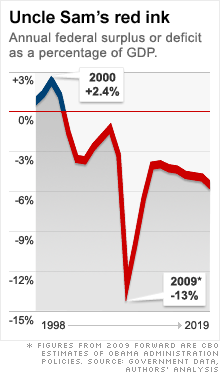
The Cause of the Deficit and Why it Matters

chart_budget_deficit.03.gif

When George Bush took office at the beginning of 2001, the federal government was running a substantial budget surplus and projected rising surpluses "as far as the eye could see." Now, the United States is facing massive current deficits -- as a share of the economy, the largest since World War II -- and an increasingly dire and unsustainable outlook over the next 10 years and beyond.

How did we get into this fiscal mess? To quote a character in Ernest Hemingway's classic novel, "The Sun Also Rises," when asked by another how he lost his wealth, "Two ways. Gradually and then suddenly."

The gradual part was a series of policy actions adopted during the Bush administration. In 2001, the Congressional Budget Office projected that the 2008 budget would show a surplus equal to 4.5% of gross domestic product. The actual 2008 budget ran a deficit of 3.2% of GDP. Almost all of the reversal was the result of policy changes -- tax cuts and spending increases.

Then, in 2009, the bottom fell out.

Click here to read more

Sunday, February 1, 2009

Minority Communities Lost $213 Billion due to Predatory Lending

The social advocacy group United for a Fair Economy just released a study stating that the cost of the mortgage crisis has been $213 Billion to minority groups.  The cost was calculated over the 8 years of the Bush Administration.

"Millions of African Americans lost their homes as a result of predatory lending and complicated contracts," says Dr. Boyce Watkins, Finance Professor at Syracuse University.  "This was a double whammy for senior citizens, including my own grandfather."

The report was entitled "Foreclsure: State of the Dream".  In fact, the study concludes that the impact of the crisis on the Black community was "the most massive loss of wealth for African Americans in U.S. history."


Monday, January 5, 2009

The Scary Side of Our National Debt Explained By Black Finance Expert Boyce Watkins


Dr. Boyce Watkins
www.BoyceWatkins.com

Brought to you by The Great Black Speakers Bureau - The #1 Speakers Bureau in the world.

Hey Peeps,

I thought you guys might want to hear Barack Obama's latest pitch as he works to solve one of the greatest economic crises since The Great Depression. It is here if you'd like to take a look. I agree with the President that bold moves by our government are necessary. Where we differ is that I do not believe it to be reasonable to think that our economy, stock market, economic growth or employment numbers are going to reach prior levels any time soon. That's because much of our economy one year ago was an illusion....a mirage created by easy access to credit sparked by a poorly regulated financial system. We are effectively the great athlete trying to compete after his steroids have been taken away: The athlete might be good, but his natural talent will likely never match his performance when it has been enhanced by doping.

More importantly, it is critical that each of us seriously considers the long-term financial damage that has been done to our economy. Even worse than our financial system, our political system is one that promotes the kind of short-sighted behavior that will surely cause serious financial problems for our children and grand children. I apologize for sounding like an alarmist, but I must be blunt: Get your money together RIGHT NOW, or there may be hell to pay in the long-term. The data from my research show that this is simply the beginning of very serious long-term financial problems in our great nation.

Our money advice email list is here, feel free to join. If there is a way that my training in Finance can help you or your family overcome financial challenges, I'd be happy to share what I know.

Be well,
Dr Boyce
www.BoyceWatkins.com

*************************************************************************************

The Scary Side of Our National Debt
By Dr. Boyce Watkins
www.BoyceWatkins.com

As a finance professor, I become nervous when listening to the numbers being tossed around by our federal government. I hear “700 billion for this and 800 billion for that” mentioned as casually as a man tossing dollar bills at a strip club. Our government officials have been wasteful, incompetent and incredibly myopic in the way they’ve managed our money. Even conservative Republicans are spending like financially illiterate rap stars, and the Obama-mania train doesn’t seem interested in taking a different track.

Added to the $400 - $700 Billion that President Elect Obama wishes to spend on a stimulus package (not to mention bail-outs for automakers and other parts of the economy), the total amount of money our government has seriously considered allocating to solve the financial crisis has approached the $2 Trillion dollar mark. In case you’re wondering, that is A LOT of money, even for government officials who think that money grows on trees.

The truth is that, like the star quarterback who thinks his money will never run out, our country is going to wake up one morning, only to realize that we are no longer financially secure. We are going to be alarmed by the prospect that our government securities are no longer considered risk-free investments. Like the worried mother who notices she is one paycheck away from being homeless, we will see that we are one terrorist attack away from being stripped of our vast economic power.

To put the $2 Trillion dollar problem into context, consider this:

- Our government’s annual income (IRS receipts coming from money you and I pay in taxes) is about $2.5 Trillion dollars.
- Our national debt has reached the $10 Trillion dollar mark. That is like a man earning $250,000 per year, and sitting on a million dollars in debt, with full intention of obtaining more debt because he believes he is too rich to go broke.
- Roughly 42% of the Federal budget goes toward entitlements: Medicare, Medicaid and Social Security. Another 20% goes to making sure we can arbitrarily “liberate” other countries who happen to have plenty of oil (the military), and another 9 – 10% goes toward paying the interest on the national debt.
- Our population is aging – this implies that our productivity as a nation is going to drop over the next 30 years, and our real Gross National Product is likely to drop with it. In conjunction with our decline in productivity, our obligations for the "Big Government 3" (Medicare, Medicaid and Social Security) are going to grow. So, the guy I mentioned above with a million dollars in debt is also going to see his income decline, while watching his expenses go up.

Translation: our country is in serious financial trouble. Trickle down economics (as proposed by these bailout plans) almost never works. I am amazed that we live in a country in which the same irresponsible men who caused the crisis are the first to be rewarded with a government bailout. The next time someone attempts to argue that Black males or young single mothers lack personal responsibility, I am going to point to the bankers on Wall Street and our government officials as being far more damaging to our nation. The real welfare recipients live on Wall Street, Capitol Hill and in executive suites, as they beg and plead for government assistance that is being granted at will. All the while, I hear politicians (even the great Black man in the White House) tell Black males with nearly 50% unemployment that they just “need to be more responsible”.

What are the solutions to this problem? There really are no quick solutions, but this might be where President Elect Obama can start:

First, stop declaring expensive wars that don’t make any sense. The Iraq War costs our nation roughly $340 million dollars per day and a combined total of half a trillion dollars. That’s enough to send over 10 million kids to college or to pay a year’s worth of health insurance for 100 million people. You could also provide $100,000 dollars worth of mortgage relief to 5 million American families.

Second, stop electing incompetent people to the most challenging office in the land. Choosing President Bush to run our country means that we deserve whatever consequences come from allowing arrogant Ivy League privilege to override the importance of competence, intelligence and solid leadership. With all the bogus and racist claims that Black youth are crippled by anti-intellectualism, it’s funny that nearly 50% of our nation planned to elect a Vice President who doesn’t know that Africa is a continent.

Third, stop throwing our children’s futures into the garbage. Millions of powerful minds are being wasted each year by a horrible inner city educational system. The money spent on the war in Iraq could have saved the lives of these youth and turned them into productive Americans. Instead, many of them are only going to be prepared to milk the economy for more costly entitlements.

Fourth, stop incarcerating many of our most productive citizens. We pay roughly $23,000 per year to incarcerate criminals, plus an average of $24,000 per year/per inmate for community corrections officers and other supervisory officials. Spending that money to educate and rehabilitate these individuals would not only increase our nation’s productivity, it would further reduce reliance on government support given to those who’ve been marginalized or had their families destroyed by our barbaric system of incarceration. This doesn’t count the impact on health effects that would come by simply stopping the prevalence of prison rape and transmission of disease within many communities across America. All chickens eventually come home to roost, even when they’ve been given 25 to life. The incarceration of productive Americans is an inter-generational loss, since their ill-nurtured children then become society’s worst nightmares.

Finally, our elected officials must stop thinking that they have a blank check. Sorry Senators, but you don’t. Money is finite, and when you keep piling up debt like MC Hammer, you’ll find yourself broke after your next album. Around the world, massive wealth appears and disappears in a flash, and by continuing our irresponsibility, we are setting the stage for the twilight of our great nation. Our officials must be more responsible and the American people must demand limitations on the use of federal debt.

Every great empire has a sunset. Many successful individuals and entities are brought down by a crippling vice, addiction or series of poor choices. America's love of debt, arrogance in leadership and unwillingness to plan for the future may be the poisons it has picked to undermine our global prominence. Protect yourself and your family, for there are bumpy times ahead.

Dr. Boyce Watkins is a Finance Professor at Syracuse University. He does regular commentary in national media, including CNN, ESPN, BET and CBS Sports. For more information, please visit www.BoyceWatkins.com.

Saturday, November 29, 2008

Trustworthiness of The Government In Protecting Our Money


By Dr. Boyce Watkins
www.BoyceWatkins.com

Media reports show that many Americans are not quite sure of what to do with their money. Watching banks fail left and right, people are logically afraid of what might happen to their savings. This fear is justified, as we are seeing our accounts beaten and stomped by the global financial meltdown.

This grave concern is magnified by the fact that those we’ve trusted are the ones who’ve left us vulnerable. Our most cherished financial experts handled our retirement accounts like flashy vehicles on a Nascar speedway. Our elected officials allowed executives in the banking industry to run rampant like 3-year olds with dirty diapers. Then, when the crash came, a massive bailout package was created for those most responsible for the damage, while the rest of us were left holding the tax bill.

This begs the question: Why in the hell should we trust the government?

I recall that during the failure of Enron, one of the most respected companies in America at the time, the firm made several statements designed to create confidence in the company’s financial condition. Like captains of the Titanic, company leaders explained that there was nothing to worry about, even as they themselves were preparing their lifeboats. When the company failed, those who did not protect themselves reminded us of one grim and fundamental truth: when the “you know what” hits the fan, it’s every man for himself….and every woman too, in case you’re wondering.

In response to such sentiment, the American consumer has been working overtime to protect his/her resources: people have (against my advice) moved their money away from the frightening stock market, they are diversifying money into different banks, and some are taking their money out of banks altogether. All of these actions are occurring in spite of government calls for calm in a world on the verge of financial panic.

The honest to goodness truth is that I don’t blame Americans for being afraid. I don’t blame them for not trusting the government right now. Trust must be earned in any relationship, whether it is a tough marriage of the relationship between a government and its citizens. Our government must work to regain that trust through sound and efficient financial management. It will NOT regenerate the public trust through excessive spending on meaningless wars, selfish pork-filled bills being passed through Congress and budget deficits that strain the resources of Americans everywhere.

I can’t tell you if the government is lying to you, but I can tell you this: There was a time when government guarantees such as FDIC insurance were as pure as the driven snow. There was a time when the United States Federal Government had pockets and resources so deep that even God himself could be bailed out with our cash. The sad truth, however, is that no empire lasts forever, and there is destined to be a day in the future when we are no longer the unquestionable economic super power that we once were. A country that can’t even afford its social security obligations is hardly a nation that has risen beyond economic risk.

Another sad truth is that if the financial world really were coming to an end, the citizens would be the last to find out about any such crisis. We would, simultaneously, be the first ones asked to suffer the burden of irresponsible behavior by our leaders. If that doesn’t justify a bit of skepticism, I am not sure what does.

Dr. Boyce Watkins is a Finance Professor at Syracuse University. He does regular commentary in national media, including CNN, ESPN, CBS and BET. For more information, please visit www.BoyceWatkins.com.

Monday, October 13, 2008

"Dr Boyce Watkins on Credit Reports"


By Dr. Boyce Watkins
http://www.drboycefinance.com/


Where do Credit Scores come from?

Unlike babies, credit scores do not come from a financial stork. There are 3 major credit bureaus in the United States: Experian, Trans Union and Equifax. Companies subscribe to their services to obtain information about you to decide if you are credit worthy or not. Under the old system, the credit scores ranged from 375 to 900. Under the new VantageScore system, they range from 501 to 990. The new system is more consistent among various credit bureaus, so you don’t end up with scores that go all over the place.

How can I get a copy of my report?

I personally go to a site called Myfico.com, where you can order reports from all 3 bureaus or just one. You can also go to freecreditreport.com (you know, the site with the really funny commercials). The law says that you are entitled to at least one free credit report every year. Also, if you are denied credit for any reason, you can write the bureaus, sending along a copy of the rejection letter, and request a copy of your credit report. If you choose to pay for your report, it will likely cost you about $8 dollars.


What factors go into calculating a credit score?

The factors that go into calculating a credit score are a little vague and it’s protected like the recipe for KFC chicken. While the formula is well-guarded, we do have some guidelines on what factors are theoretically used to determine whether or not someone should loan money to you.

The factors are broken into what they call “The Four C’s of Credit”: Character, collateral, capacity, capital and conditions.

Character is their way of trying to decide if you are a good person or not. I don’t agree with this, since having bad credit does not make you a bad person. It just makes you a person who does not have a good track record when it comes to borrowing money.

Capacity is represented mostly by your income level and how much money you’re expected to earn in the future.

Capital is noted by the amount of cash you have in reserves and other liquid assets at your disposal. If you have capital, that means you can withstand a short-term decline in income and still make payments.

Conditions are reflected by the environment in which you live. It might include the state of the economy, your line of work and other external factors that might impact your credit report. For example, during the liquidity crisis in America, conditions for lending are very, very bad.

Now you know where credit scores come from. You probably have more questions, since there is a lot of ground to cover. To get more information, please feel free to learn along with me and my students by visiting http://www.drboycefinance.com/.

Dr. Boyce Watkins is a Finance Professor at Syracuse University. He does regular commentary in national media, including CNN, ESPN, BET and CBS. For more information, please visit http://www.boycewatkins.com/

Wednesday, October 8, 2008

The Financial Crisis and Bill Collectors


One of the groups that was not bailed out during the recent financial crisis has been the American consumer. Congress took care of the firms on Wall Street, but they didn’t take care of the millions of Americans forced to confront the realities of bankruptcy, foreclosure and uncomfortable confrontations with menacing bill collectors. It appears, sadly, that every man and woman must find their own way through this financial tragedy.

Bill Collectors really want their money, like the rest of us. Some of them seem to feel that it’s O.K. to resort to flat out thuggish intimidation to get their money back. That might work on The Sopranos, but it shouldn't work in real life.

Part of the reason abusive bill collectors can have their way with the public is because many citizens do not know their rights. Bill collectors prey on the uninformed in a terrible way: They may threaten to have you arrested, harass your relatives, call all hours of the night, and engage in other types of atrocious behavior to get their money out of your hide.

One woman successfully sued a rogue bill collector after he called her repeatedly with threatening language. The woman, a senior citizen, was told by the man to "Stop with the sob stories and pay your god d*m bill!" This kind of behavior is not acceptable, and bill collector harassment doesn’t have to keep you up at night.

The Federal Trade Commission states that complaints against bill collectors are rising, reaching the highest level they've seen in the past 3 years. Most of the complaints focus on vulgar language, trying to collect more than the amount of the true debt, and extra fees, such as court costs.

You have rights that can protect you from bad and malicious bill collectors. You want to keep these in mind as you work yourself out of debt:

1) There is something called "The Fair Debt Collection Practices Act". If you are not familiar with this document, get familiar with it. You can read it by clicking here.

2) A bill collector cannot contact you at work if your employer does not approve of the contact. Let the bill collector know that this is the case and they must legally stop contacting you at your job.

3) Bill collectors cannot call you before 8 am or after 9 pm. The only exception is if you give them permission to do so.

4) A bill collector can only contact your friends and family if they are trying to find a way to get in touch with you. However, some of them may do this in order to harass or embarrass you. If that is the case, you may want to tell your friends to tell the bill collector, "She does not live here and I do not know how to get in touch with her. Please don't call here anymore." Then, get the bill collector's information from your friend and reach out to them when you can.

5) You can get bill collectors to stop contacting you altogether by sending them a letter telling them to stop. You still must pay the debt, but they won't be calling you during dinner.

6) The bill collector cannot curse at you or use foul language and they must tell the truth about how much you owe. They cannot threaten to sue unless they are serious about it, and they can't touch your 401k or IRA.

7) If the bill collectors call you, you can demand that they send you a written notice of the amount you owe and who you owe the money to. If you do not believe that the debt is yours, you can write a letter to them stating that this is not your debt. They must then send you proof that the debt is actually yours.

If you feel that a debt collector has violated any of these rules, you can contact the Federal Trade Commission at www.ftc.gov. Remember that you are not powerless in this situation.

Dr. Boyce Watkins is a Finance Professor at Syracuse University and author of Financial Lovemaking 101: Merging Asset with Your Partner in Ways that Feel Good. He does regular commentary in national media, including CNN, CBS, NBC and BET. For more information, please visit www.BoyceWatkins.com. This information does not constitute legal advice. For legal advice, please consult your attorney.
Monday, September 29, 2008

Financial Crisis 101: A Finance Professor's Perspective

The Financial Crisis: A Finance Professor's perspective

by Dr. Boyce Watkins
www.BoyceWatkins.com

1) FDR had it partially right when he said that "We have nothing to fear but fear itself." While we have other worries as well, the greatest obstacle to economic progress is the HUGE psychological impact of Americans watching the stock market plummet right in front of their faces. This is going to cause consumer spending, lending, borrowing and investing to freeze like a deer in stadium lights. When people stop spending, economies start dying.

2) This crisis was a long time coming. De-regulation pushes down on the economic gas, but increases the chances of an economic crash. The dramatic growth of the past 8 years was a result of the same policies that are leading to the huge challenges we are faced with today.

3) Much of the impact of this crisis is a financial illusion. A large percentage of the devaluation in stock and home prices is driven by the fact that the original value was incorrect in the first place. When prices are out of whack, they must correct themselves. While a crisis may also be a correction, a correction is not necessarily a crisis.

4) Prepare for a period of "Financial McCarthyism" in America. Many baby boomers are closing in on retirement, and scared to death. To boot, many of these individuals have not properly prepared for retirement. When Americans get scared, politicians get nasty. We will likely see some of the most Draconian legislation in history.

5) What makes this crisis such a concern is that even before the meltdown, the economy was already quite fragile. With soaring gas and food prices, the economy was the #1 issue on the minds of most Americans. The decline of many financial services firms was, for the most part, a logical continuation of the fact that many homeowners were defaulting at the start of the year. This crisis is most certainly going to shift the political landscape and might give us our first Black president.

Dr. Boyce Watkins is a Finance Professor and author of the forthcoming book "Black American Money". He does regular work in national media, including CNN, ESPN, BET and CBS. For more information, please visit www.BoyceWatkins.com

Sunday, September 28, 2008

What the Crisis Means for Black America

Dr. Boyce Watkins
Hey peeps,
Tom Joyner and I are going to talk Personal Finance and Money on 10/13 at 6:30 AM EST. I was also invited to discuss the liquidity crisis on Rev. Jackson's show. I've been doing most of my commentary on NPR and non-black media, so I was very happy to have the chance to discuss the Black perspective on this important issue. In fact, the article below addresses something that I feel has been missed: How this crisis impacts Black America.
If you want to join our money group to receive regular commentary on money and finance, please click here.
Valencia Roner, a very talented radio show host, did a thought-provoking show with me on the liquidity crisis. You can listen to the interview by clicking here.
The Liquidity Crisis of 2008: What Black People Should Do Now

By Dr. Boyce Watkins

www.BoyceWatkins.com

Most of you have been watching politicians shuck and jive in predictable ways to try and manage the even more predictable liquidity crisis that has terrorized our financial markets. As a supporter of Senator Barack Obama, I am hopeful that this will serve as the final signal to America that a Harvard graduate with extensive Economics training might be a better choice than a mediocre student who claims to know nothing about the economy. I won’t even mention Sarah Palin, who now makes George Bush the runner-up in the “Unfit to Manage a Burger King” contest. I am not big on Obama-mania, but I tend to be big on common sense. It is also telling that many Americans would sacrifice our nation’s future in order to avoid the discomfort of seeing a Black man in the White House. OK, let me shut up before I say what I REALLY think.

This is not about the pale one called Palin or John McCain’s Black Extermination Plan for criminal justice. It is about USOBA. USOBA doesn’t stand for the “United States of Obama”, rather, it stands for the “United States of Black America”. This is about finding ways to manage, contextualize and internalize this crisis so we can figure out what to do right now. Neither McCain nor Obama is going to take care of you and your family, since politicians tend to take care of themselves (note Treasury Secretary Henry Paulson’s prior affiliation with Goldman Sachs will likely drive his desire to save his Wall Street buddies). The truth is that we are all Presidents of our own households, and as President, your job is to shield your household from the impact of FICA - The Financial Ignorance Crisis of America. Here are some quick thoughts:

1) The government bail-out doesn’t necessarily mean you should bail-out of the Stock Market: If you are invested in the Stock Market, I would strongly consider staying there, especially if you are under the age of 50. In fact, you might want to buy more stocks. Warren Buffett (a man who is sometimes wrong) had it absolutely right when he said that you should “be greedy when everyone else is cautious and cautious when everyone else is greedy.” Drops in the Stock Market can be the best times to invest because the historical data clearly shows that when the US Stock Market declines, it eventually comes back up. Personally, I plan to use this market decline as an opportunity to expand my portfolio. But I am not going to try and pick individual companies: I am going to buy into a diversified mutual fund that spreads my money around the entire global economy.

2) Paying off credit card debt is one of the best investments you can make: Which would you prefer? To possibly earn 10% interest in an investment in the Stock Market or to DEFINITELY save 18% per year on that high interest credit card in your purse? Remember that money SAVED is money EARNED. Get rid of the bulk of your high interest debt before you even consider investing in the Stock Market or anywhere else.

3) Change the game: With all of Barack Obama’s speeches about how Black men need to learn personal responsibility, he may have wanted to save that speech for the rest of America. The typical American consumer has been incredibly irresponsible with spending, saving, borrowing and investing habits over the past 20 years. I grow sick of seeing one article after another attempting to argue that African Americans have a monopoly on irresponsible financial behavior. Don’t believe the hype – ALL OF AMERICA has a problem with financial choices. The goal is not for you to emulate the behavior of the rest of America….it is to set a new standard. Black people can be quite good at saving money. Many of our grandmothers could support a household with two nickels and a hot dog bun. Perhaps we can tap into our natural survival instincts to get us through this mess.

4) This crisis might be the tip of the iceberg: I agree with my respected colleague Paul Krugman at Princeton, who is the only other commentator I’ve heard mention that recent financial problems may be nothing more than a symptom of more serious fundamental issues in the US economy. All I could say when I heard that was “Amen”. Without going into much detail, I can say that it is time to remember that old saying “Learn to save your money, so your money can save you.”

5) Don’t be “scuuuurred” (translation for the uppity among us: “Don’t be afraid”): This is NOT the end of the world. The financial systems are not going to melt down. This is not likely going to be the start of any kind of Great Depression. Truth be told, the Black community has been in a Great Depression for about 400 years! We have survived worse, and just because the economy struggles, that doesn’t mean you have to struggle along with it. Remember that our greatest challenges are usually our greatest opportunities for growth. Learn from this experience, grow from it, and we will continue to move forward.

Your financial liberation is part of your social and spiritual liberation. Let’s use the shake-up as an opportunity to shake ourselves off the plantation. I’m tired of someone else owning me.

Dr. Boyce Watkins is a Finance Professor at Syracuse University and author of the forthcoming book “Black American Money”. For more information, please visit www.BoyceWatkins.com.

Monday, September 22, 2008

Dr Boyce Watkins: Black American Money


I should begin by saying that I am not a Finance Professor who happens to be Black. Rather, I am a Black man who happens to be a finance Professor. The goal of this work was not to create yet another book analyzing money to the nth degree, discussing stocks, bonds, charts and portfolios. I see money as a tool for the enhancement of life and the liberation of a people. I also see money as part of a nexus of critical issues that drive the world in which we live.

So, this book is not going to be about money throughout. It does not contain a long list of nuts and bolts financial advice. It is a discussion, by a Black social commentator who cares about his people, who also happens to be an educator and a Financial expert. So, imagine a person who is an expert at cooking steak, chicken and carrots, but insists upon making sure the plate has a little bit of each. I have never been one dimensional in my analysis, because linear, limited thinking is how one consistently misses the big picture.

In this book, you are going to get first hand analysis of how money plays a role in critical Black issues and leadership, from The State of the Black Union to Civil Rights. I will openly and honestly share my behind-the-scenes experiences with CNN, FOX, ESPN and other networks. You will hear about academia, as I take you for a quick trip into the ivory tower for a discussion of how economic incentives impact the value systems of today’s “Blackademics”. The trip will be long and broad, and won’t just focus on money. Rather, the focus is on capital of all types, not just financial capital.

Money, like any other powerful object, can either be incredibly constructive or horrifically destructive. It can ruin families or make people strong. It can liberate, enslave and do everything in between. You can improve the lives of those you love or ruin your relationships with loved ones. Money can do many amazing things in a capitalist society. Therefore, understanding money, embracing the power of money and controlling the power of money is clearly, without question, an undeniably meaningful part of the movement toward equal rights.


This was an introduction to the forthcoming book "Black American Money", written by Dr. Boyce Watkins. For more information, please visit www.BoyceWatkins.com.